

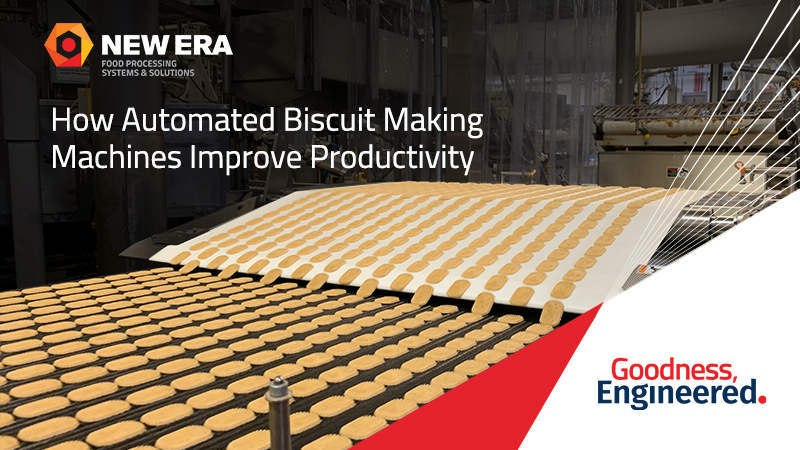
What if a biscuit-making plant could increase biscuit output while maintaining consistency in quality and minimising production losses? This is something that can be accomplished through automation. Automation is achieved by integrating the manufacturing processes into a unified production system.
Conventional biscuit production requires repetitive manual work, varying methods of dough processing, intermittent production, and wasteful usage of raw materials. This leads to restricted production levels and high operational costs amid the surging demand for biscuits.
Let’s learn more about how automated machines enhance productivity.
7 Reasons How Automated Biscuit Making Machines Improve Productivity
1. Faster Production with Continuous Operations
Depending on how demand varies, manual production methods may not be very consistent. Coordinated mixing, feeding, forming, baking, and post-baking operations are made possible by the use of automated equipment, which helps to ensure a stable production flow in manufacturing.
An example of production lines for hard dough biscuits includes a precision sheeting line, a dough lamination line, a cutting line, and a continuous baking line. This decreases the number of delays between stages and enables manufacturers to increase throughput without completely depending on extra workers.
This leads to a more predictable production process, increased capacity utilisation, and better control over the daily production.
2. Consistent Biscuit Shape, Size, and Weight
Uniformity is very important in meeting the needs of customers. Any deviation from the uniformity in dough thickness, size of the cuttings, and number of biscuits produced may result in poor-quality baking.
These variables can be controlled with automated forming systems. Rotary moulding machines for soft dough, while wire-cut machines, depositors, and extruders make various styles of cookies with greater accuracy.
The line that makes soft dough biscuits can be considered a good example for making soft biscuits and shortbread biscuits. The correct process of shaping and handling the dough provides uniformity in the production process, which means that there is no need for manual correction.
3. Reduced Labour Requirements and Repetitive Tasks
In the process of biscuit production, manufacturers need to transport the dough, feed the machinery for shaping the dough, monitor the production process, and transport the final biscuits for packing. This growing production demand increases the requirement for human resources.
Automation minimises human assistance and optimises controls in production. It provides the possibility for operators to focus on monitoring the process and checking the quality of products.
Automation does not mean that there will be no need for human resources, rather, it will enable effective distribution of the labour force and will decrease the amount of boring work.
4. Better Raw Material Utilisation and Less Wastage
The wastage of ingredients can have a large impact on the manufacturing costs of the processes that use large amounts of flour, sugar, fats, and other components. The loss of production could take place due to the failure to distribute the dough evenly, the absence of portioning, inefficient cutting, or discarding the items in production.
This situation could be resolved using automated biscuit-making machines with controlled feeding, accurate forming and repeatable process parameters. Product variations are also minimised due to consistent dough thickness and cutting.
Waste reduction is dependent on the recipe, conditions of the equipment, the way the equipment is operated, and the opportunities for reusing a suitable dough scrap. However, with improved process control, manufacturers have a greater chance to enhance material efficiency.
5. Improved Baking Control and Energy Efficiency
The baking process is one of the most important stages of biscuit manufacturing as it affects the parameters such as moisture, colour, and texture of the biscuits. In fact, improper heating or baking conditions may lead to either underbaked or overbaked biscuits as well as uneven colour.
The baking equipment that is used for the biscuit manufacturing process has controlled heating that helps provide continuous baking with permanent baking characteristics.
So, successful baking allows maximising productivity due to the reduction of product rejection and energy consumption.
6. Smoother Cooling, Stacking, and Packaging
Although cookies have already been baked and are meant to be placed into boxes, before doing so they must be appropriately cooled down.
When cooling or stacking is not even, it results in accumulation of finished products between baking stages. This produces bottlenecks which can reduce the facility’s production capacity even if the oven is able to produce the required amount of product.
Post-baking systems can be employed to manage the cooling conveyors, turntables, stackers, and packing areas. As an example, cooling conveyors and stackers allow cookies to pass quickly through the packaging process, which reduces the amount of manual labour required.
The key is finding the right balance among the speed of each stage. If cooling and/or packaging is limiting, then increasing the output of the oven will not enhance overall productivity.
7. Greater Flexibility and Easier Production Management
Consumer tastes can change frequently, requiring cookie makers to have new cookie shapes, ingredients, and flavours. Non-flexible machines can create delays in changes in production and lower production rates.
Automation systems offer advantages such as recipe control, operating variable settings, and shape formation flexibility. They assist manufacturers in controlling various products while keeping the process consistent.
The efficiency gain is due to the flexibility factor, quick changeover system, and reliable processes.
Measuring the Productivity Gains from Automated Biscuit Manufacturing
Automation is of maximum benefit when producers evaluate its impact on the general production cycle rather than only measuring machinery’s speed. Some performance indicators include hourly production output, yield, machines’ downtime, productivity of labour, energy consumption per unit weight, and percentage of defective products.
In fact, manufacturers experienced an overall increase of between 10-20% in production efficiency and a productivity increase of between 7-20% once smart manufacturing was adopted.
A crucial aspect for biscuit producers is to identify the main bottlenecks of the production process that hinder their work before buying any new machines. Once these bottlenecks are addressed, throughput can be improved.
However, this must be counterbalanced by taking into account the costs of capacity calculations, employee training, and preventive maintenance.
Conclusion
Automation is very important in biscuit production since it leads to increased production capabilities. The decision on the machinery type to purchase depends on the knowledge about products, expected volumes, factory design, energy consumption, and possible future development.
Working together with reliable biscuit making machine manufacturers enables you to get production systems that fit the requirements without compromising quality or reliability.
New Era provides integrated production lines for hard dough biscuits and crackers, soft dough biscuits, and cookies, and helps manufacturers set up production systems tailored to their requirements.
Explore New Era Machines’ production lines to find the right solution for your biscuit manufacturing needs.
FAQs
- How do automated biscuit making machines enhance productivity?
With the use of these machines, mixing, feeding, forming, baking, cooling, and post-baking handling are made easier, which helps reduce stoppages and manual activities in production. Therefore, producers are able to generate more products while maintaining the original biscuit quality.
- Can automated biscuit making machines reduce production costs?
Yes, they can minimise unnecessary waste, repetitive labour, product rejection, and inefficient energy use. Actual savings will vary with equipment choice, operating conditions, maintenance, and production volume.
- Which factors should manufacturers consider when choosing biscuit making machines?
The factors to consider include production capacity, biscuit type and dough features, ovens, and cooking space. Another aspect to account for is the flexibility of the machinery.