

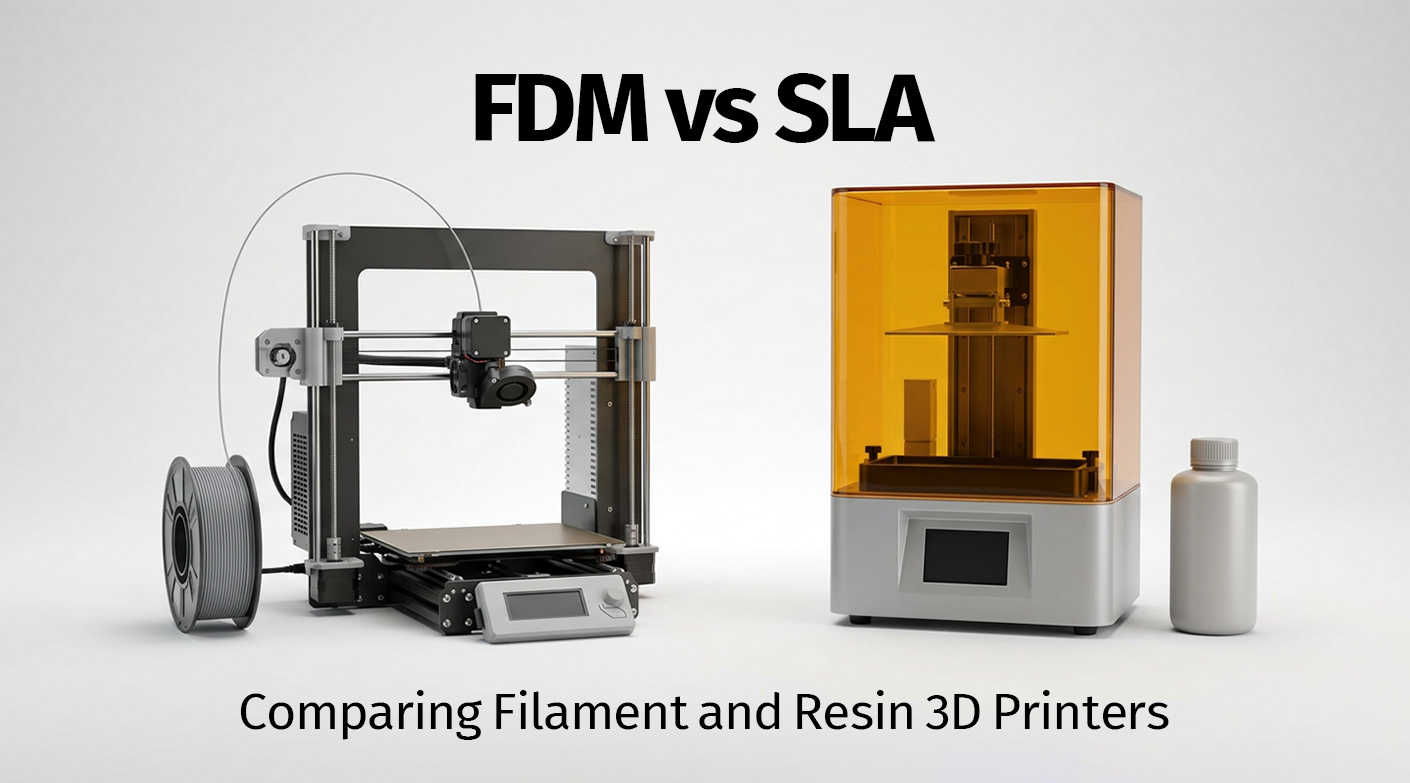
Which factors matter most for your 3D-printed component: strength, surface finish, or fine detail? Understanding these requirements can help you determine which printing process is more suitable for your project. Two commonly used methods are fused deposition modelling (FDM) and stereolithography (SLA).
Both technologies build components layer by layer, but they use different materials and mechanisms. The first method involves melting thermoplastic filament, while the second method includes the application of light for curing liquid material; therefore, these technologies lead to both visual and mechanical differences.
What is FDM 3D Printing?
The process of fused deposition modeling (FDM) involves using heated thermoplastic filament and solidifying it into the desired shape. This process is popular in the area of prototyping, as it allows for quickly creating functional parts.
The process begins with creating a 3D model, which is then converted into machine-readable instructions using slicing software. After producing the requirements for operation, the printer takes plastic filament from the spool and introduces it into the hot area of high temperature where it melts.
What is SLA 3D Printing?
Stereolithography (SLA) refers to a method of 3D printing that uses digital CAD data by curing liquid photopolymer resin layer by layer using an ultraviolet (UV) laser or light source
Unlike FDM, which uses lasers to solidify small amounts of liquid resin, with SLA , the object is created by laying down melted thermoplastic in very thin layers.
After printing, the component is cleaned to remove uncured resin and may undergo additional UV curing, depending on the material and process requirements. Also, any necessary support structures can be removed.
FDM vs. SLA: Understanding the Key Differences
Although both technologies create components from digital models layer by layer, both technologies apply different materials and technologies to accomplish their purpose.
1. Printing Technology and Materials
FDM components are produced using the process of melting thermoplastic and extruding it through the nozzle. The material is deposited layer by layer and cools as the component takes shape.
SLA uses light to cure the liquid photopolymer resin. This enables the production of intricate geometries and fine details, depending on the printer’s resolution, material, and process settings.
FDM is commonly used for functional thermoplastic components, while SLA is often preferred for parts that require fine details and a smooth surface finish.
2. Surface Finish and Level of Detail
The surface quality is one of the most noticeable contrasting aspects between FDM and SLA.
Generally, FDM components typically show visible layer lines, particularly on the curved surfaces and angular features of the parts. The appearance of these lines may be reduced by printing parameters, including nozzle diameter, print patterns, and others.
SLA generally produces smoother surfaces and finer details, which makes it useful for the production of models with detailed textures, lettering, and complex shapes.
Neither process guarantees perfect dimensional accuracy. The final result depends on the machine setup, properties of the used material, geometry, and orientation of the parts.
3. Strength and Functional Performance
When material selection, printing shape, and other parameters are accurately selected, the printed parts perform excellently, being ready for implementation in real-life situations.
However, their strength may differ in different directions due to the different interactions between layers being printed and the printable material within the layers.
While SLA parts can be fabricated with complex geometry, conventional photopolymer materials tend to be more brittle than the thermoplastics found in FDM. There are some specialised engineering resins that offer better rigidity or flexibility, but the properties of the resin are dependent on the formulation and curing process.
4. Printing Speed and Production Time
Printing time depends on the printer, component size, layer height, material, and required level of detail.
FDM can be effective for larger components where fine surface detail is not the priority. However, the production time increases significantly when making tall components because the printer must deposit many layers to build the required height.
Businesses should consider printer capabilities alongside the time required to produce the component. When projects have strict deadlines, this difference can affect technology selection.
5. Cost of Printing and Post-Processing
The cost of FDM and SLA printing depends on the equipment used, the material applied, the form of the goods produced, the volume of production, and the level of post-processing required.
FDM can be more economical for some components and prototypes because thermoplastic filaments are widely available and post-processing may be relatively straightforward. On the other hand, SLA can involve higher material and finishing costs if special resins, cleaning equipment, protective equipment, and labour are necessary.
To be able to compare the costs in the right way, companies should take into account the overall expenditure of producing a good part, which should include energy costs, usage of machines over time, labour costs, post-processing costs, and the costs of reprinting.
6. Design Complexity and Part Size
FDM is an efficient 3D printing method. It may be efficient for medium parts, but if you have to construct something with overhangs or complicated inner structures, it needs to be altered.
That is why SLA technology is more suitable for small details and intricate shapes. Still, it is worth noting that printer settings and positioning of possible support structures are also very important.
However, the build size varies from printer to printer. So, it is always a good idea to compare models rather than assume that all FDM printers produce bigger models than SLA printers.
FDM vs. SLA: A Quick Comparison
| Comparison factor | FDM 3D printing | SLA 3D printing |
| Material | Thermoplastic filament | Liquid photopolymer resin |
| Surface finish | Visible layer lines may appear | Generally smoother surface |
| Fine details | Suitable for moderate detail | Excellent for intricate details |
| Material performance | Depends on the thermoplastic and print settings | Depends on the resin formulation and curing |
| Cost | Often economical for functional prototypes | Can involve higher finishing and material costs |
| Post-processing | Support removal and optional finishing | Washing, post-curing, and support removal |
| Typical applications | Brackets, housings, fixtures, and functional prototypes | Detailed models, appearance prototypes, and intricate components |
| Main consideration | Layer bonding and surface quality | Resin handling and post-processing |
The choice of printing technology should be based on material requirements, equipment capabilities, component geometry, and the intended application.
When to Choose FDM vs. SLA 3D Printing
The choice between FDM and SLA depends on the prototype’s requirements and the intended application of the final product. Also, the market for additive manufacturing expanded by 9.1 percent in 2024 and reached USD 21.9 billion. This shows how widely 3D printing is being adopted.
Choose FDM when:
- You require functional prototypes: FDM allows the examination of the fit of a component along with its assembly as well as basic operation.
- You need larger components: Based on the size of the printer, FDM is a great option for large-scale housings and brackets.
- You need to manage prototyping costs: FDM is a viable option in the beginning stages of designing when the finished surface is of less importance.
Choose SLA when:
- You want to achieve smooth surfaces for your product: SLA is the right choice for products with a smooth surface and high-quality appearance.
- You require fine details: Certain fine details and extremely delicate shapes are better achieved with resin printing technology.
- You need detailed visual prototypes: SLA can help designers test the aesthetics of their products before they enter production.
Conclusion
Choosing between FDM and SLA depends on the requirements of the application. FDM vs. SLA might seem simple in principle, but it is not so straightforward. For many projects, FDM is the choice that makes sense due to the properties of thermoplastics. In those situations where detailing and aesthetics are paramount, SLA is better. For more complex applications, many projects can combine both processes.
Cubein provides its clients with 3D printing services in India as well as across the world. At Cubein, we provide access to guidance in the field of FDM, SLA, SLS, and other technologies, as well as assistance in industrial design and product development.
Have a product idea you want to bring to life?
Explore Cubein’s rapid prototyping services; contact us now.
FAQs
- What distinguishes FDM from SLA 3D printing?
Today, designers often select FDM for prototypes requiring functionality, while SLA is commonly associated with smooth surfaces and precise detailing.
- Is FDM cheaper than SLA 3D printing?
FDM can be more economical for some applications because thermoplastic filament and post-processing may cost less than the materials and finishing required for SLA. However, the overall cost depends on the component’s size, material, print settings, equipment, labour, and post-processing requirements.
- Which technology is better for detailed prototypes?
SLA is suitable for developing prototypes that require fine details as well as complicated geometries and smooth surfaces. Its high quality depends upon the printer used, type of resin, design, and post-processing stage.
- When to use FDM and when to choose SLA 3D printing?
In most of the cases, when the key factors are practical thermoplastics turned into parts and cost-effective iterations, FDM can be chosen, while SLA will be your best option if your project demands fine details and smooth surfaces.