

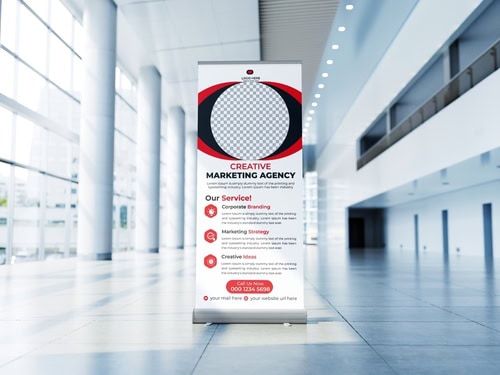
Walk into any exhibition hall, showroom, or busy retail environment and one thing becomes obvious very quickly: people make decisions before they make contact.
Long before a staff member says hello, a customer has already scanned the space, filtered what looks relevant, and formed an impression about which brands feel worth their time. That split-second judgment is where a roller banner does more work than many businesses realise. It is not just a portable sign. It is often the first conversation starter, the first credibility marker, and the first signal that tells someone, “This is for you.”
In environments where attention is scarce, that matters.
The Silent First Impression
A roller banner sits in an interesting position within customer psychology. It is passive, yet it influences action. It does not interrupt people, but it can shape whether they approach, slow down, or move on.
People decide faster than brands would like
Studies on visual processing consistently show that people absorb and judge visual information in seconds. In a trade show setting, that window can be even shorter because visitors are being hit with dozens of competing messages at once. They are not reading every stand in full. They are scanning for cues.
Those cues tend to be simple:
- What does this company do?
- Is it relevant to me?
- Does it look credible?
- Is it worth stopping here?
A strong roller banner answers those questions almost instantly. A weak one creates friction. If the headline is vague, the layout cluttered, or the message too generic, people will often walk past without consciously knowing why.
Your banner is often your opening line
Think of a roller banner as the visual equivalent of an introduction. Before your team has a chance to explain the offer, the banner has already set expectations. It can make the eventual conversation easier, warmer, and more focused.
If it clearly communicates a problem you solve, visitors are more likely to arrive with context. Instead of opening with, “So, what do you do?” they may jump straight to a specific need. That shortens the path to a useful exchange.
Why Roller Banners Still Work in Busy Spaces
For all the talk about digital displays and immersive brand experiences, roller banners remain effective because they do one thing exceptionally well: they deliver clarity at a glance.
They meet people where their attention actually is
Most customers in a physical environment are not standing still, waiting to be educated. They are moving. Their attention is partial. Often, they are taking in information through peripheral vision before deciding where to direct focus.
That is exactly why simple, well-structured display formats still perform. In practical terms, many businesses still rely on roller banners for retail and trade shows because they work within real-world attention patterns rather than against them. They can be positioned at entrances, beside product areas, or at the edge of a stand to capture interest before a visitor is close enough for a direct interaction.
The point is not novelty. It is visibility with purpose.
Clarity beats cleverness
Some banners fail because they try too hard to impress. They lean on abstract slogans, packed visuals, or too many competing messages. But in most customer-facing settings, clarity is the more persuasive choice.
A good banner should make sense from several feet away. The visitor should not have to decode it. If your message only works after explanation, the banner is not doing its job.
The strongest examples usually lead with one sharp idea: a product category, a customer problem, a value proposition, or a compelling outcome. That focus gives the eye somewhere to land.
Designing for Engagement, Not Decoration
A roller banner should not simply “look branded.” It should help move a customer from awareness to interest.
Visual hierarchy guides behaviour
When people glance at a banner, they do not absorb everything equally. Their eyes follow hierarchy: headline first, then supporting message, then image or proof point, then call to action. If everything is bold, nothing is.
This is where design has a direct effect on engagement. A clear hierarchy reduces effort. And the less mental effort a customer needs to make, the more likely they are to stay with the message.
Useful questions to ask include: What should someone understand in three seconds? What should they remember in ten? What should prompt them to step closer?
Trust cues matter more than many brands think
Before speaking to a representative, customers look for signals of legitimacy. That might be a recognisable client logo, a clear statement of expertise, a professional image style, or simply a clean design that suggests care and competence.
Poorly printed graphics, overcrowded text, and inconsistent branding can quietly undermine confidence. Not because customers are consciously critiquing the banner, but because visual sloppiness often gets interpreted as organisational sloppiness.
That is especially true at trade shows, where buyers may be comparing suppliers on instinct before they compare them on detail.
What Shuts Down Engagement Before It Starts
A roller banner can invite conversation, but it can also unintentionally block it.
One common mistake is treating it like a brochure on a stand. Too much text asks too much of a passing visitor. Another is using internal language that makes sense to the company but not to the audience. Customers do not stop because you are “innovative” or “solutions-driven.” They stop when they immediately see relevance.
Positioning matters too. Even a strong banner loses value if it is hidden behind furniture, placed in a low-traffic corner, or crowded by other visuals. Context changes performance.
And then there is the disconnect problem: when the banner promises one thing, but the person greeting visitors opens with something entirely different. That inconsistency creates uncertainty. The visual message and the human message should feel like part of the same conversation.
Measuring Impact Beyond Footfall
Not every influence is easy to quantify, but that does not mean it is vague.
Watch what happens before conversation begins
If you want to know whether a roller banner is working, observe behaviour upstream. Do people slow down near it? Do they glance, then approach? Do they arrive already referencing the headline or offer? Are initial conversations more focused when the banner is visible?
These are practical indicators of pre-engagement influence. In retail, you might measure dwell time near a display area. At an event, you might compare the quality of interactions across different messaging versions rather than just counting scans or leads.
The best banner is not necessarily the one that gets the most looks. It is the one that improves the quality of the next step.
The Real Job of a Roller Banner
A roller banner is not there to close a sale on its own. Its job is subtler and, in many ways, more important. It reduces hesitation. It creates familiarity. It gives the customer a reason to pause long enough for a real exchange to become possible.
That is the moment many brands underestimate: the few silent seconds before anyone speaks.
Get those seconds right, and your team is no longer starting from zero. The customer has context, confidence, and a clearer sense of why they should engage. And in crowded spaces, that small advantage can make the difference between being noticed and being ignored.