

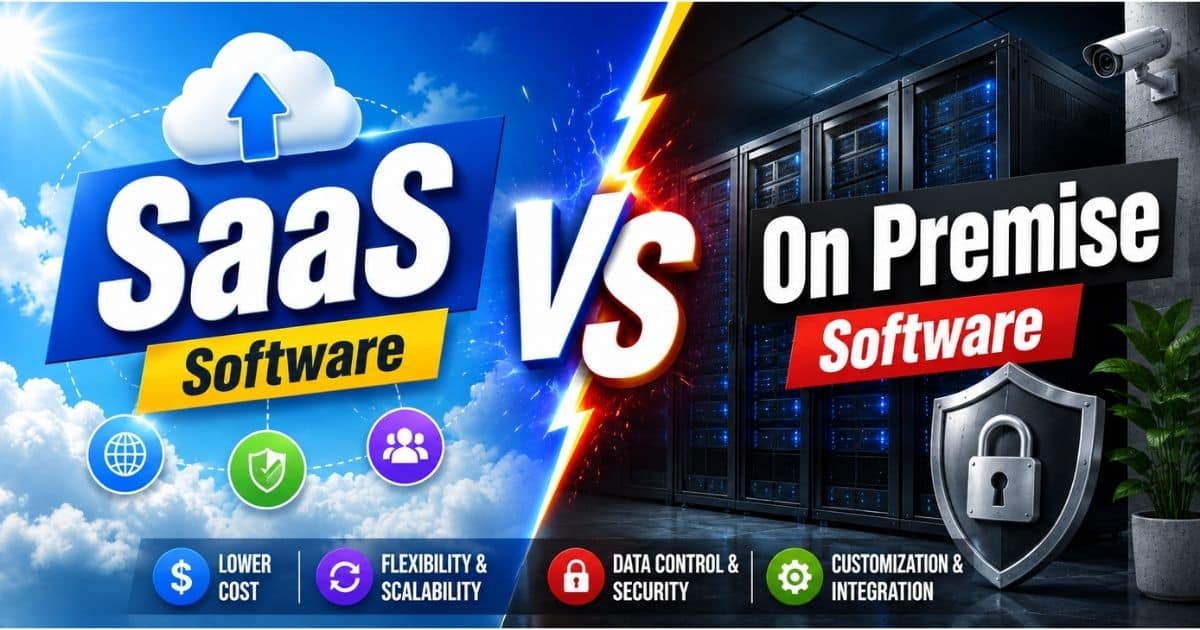
The debate used to be simpler. On-premise meant control. SaaS meant convenience. Security teams generally favored on-premises because the perimeter was visible servers in a rack, a firewall at the edge, a team that physically managed the hardware. That mental model has not aged well.
The choice between SaaS and on-premise is now a genuinely complex architectural decision, and companies that treat it as a cost conversation or a checkbox exercise tend to make it badly. The team at Viva Sync regularly helps organizations work through exactly this kind of infrastructure decision where the technical answer depends heavily on the specific data involved, the regulatory environment, and what the internal team can realistically maintain over time.
Why the Old Assumptions No Longer Hold
On-premise security used to mean you owned the risk entirely and that was considered a feature, not a bug. Your data didn’t leave your building. Your security team set the rules. Your audit logs were yours.
What that model required, and still requires, is a level of internal capability that most organizations don’t actually have. Patch management, hardware refresh cycles, physical security, network segmentation, 24/7 monitoring on-premise done properly is operationally intensive. The companies that do it well tend to be large, well-staffed, and operating in industries where regulatory requirements make the investment non-negotiable.
SaaS shifted the model. A reputable SaaS provider running on major cloud infrastructure AWS, Azure, GCP invests in security at a scale that almost no individual company can match. Their teams are larger, their tooling is more sophisticated, and their incentive to maintain high security standards is existential. A breach at a major SaaS provider is a company-ending event. That pressure produces real investment.
The trade-off is that you’re no longer the only party with access to your data. You’re operating under a shared responsibility model, whether you’ve read the documentation on that model or not.
What Shared Responsibility Actually Means
Every major cloud and SaaS provider publishes a shared responsibility model. The specifics vary, but the structure is consistent: the provider secures the infrastructure; you secure what runs on it and how it’s configured.
This matters more than most procurement decisions account for. A company can be running on enterprise-grade infrastructure and still have a serious security problem because:
- Access controls were never properly configured after initial deployment
- Former employees retain active credentials months after offboarding
- Data is being stored in the application in ways the vendor doesn’t encrypt by default
- Audit logging is available but was never turned on
The infrastructure is secure. The implementation is not. This is where the majority of SaaS-related incidents actually originate.
The Real Security Variables: What to Evaluate Before Choosing
Neither architecture is categorically more secure. The right choice depends on variables that are specific to your organization, your data, and your operational context.
Data Classification and Regulatory Requirements
Start here, not with cost. Different categories of data carry different obligations.
Personal health information under HIPAA, financial data under PCI-DSS, and personal data under GDPR each come with specific requirements around access, storage, residency, and audit trails. Some of those requirements are easier to satisfy with on-premise infrastructure. Others particularly around audit logging, encryption at rest, and access monitoring are actually better supported by mature SaaS platforms that have built compliance tooling as a core product feature.
The question is not “which architecture is more compliant” in the abstract. It’s “can I satisfy my specific regulatory obligations with this architecture, and can I prove it during an audit.”
Internal Security Capacity
This variable gets underweighted in architecture decisions because it’s uncomfortable to assess honestly. The relevant questions are:
- How many people on your security team have the skills to manage this infrastructure at the level it requires?
- What is your current mean time to patch critical vulnerabilities?
- Do you have 24/7 monitoring coverage, or does your security visibility end at 6 PM on Friday?
- When did you last run a tabletop exercise for an infrastructure compromise?
On-premises done at a mediocre level is often less secure than SaaS managed at a mediocre level, because the SaaS provider’s baseline is higher. If your honest answer to the capacity questions above reveals significant gaps, that should weigh heavily in the architecture decision.
Where Each Model Has a Genuine Advantage
Cases Where On-Premise Still Makes Sense
There are legitimate reasons to maintain on-premise infrastructure for security-sensitive data. They’re more specific than the general argument for “control”:
- Air-gapped environments: certain defense, critical infrastructure, and research contexts require systems that are physically isolated from any network. SaaS is not an option here.
- Highly customized security requirements: when your threat model or regulatory requirements are unusual enough that no SaaS provider’s standard configuration can satisfy them, building it yourself may be the only viable path.
- Existing investment and genuine internal capability: if you have a mature, well-staffed security team and established on-premise infrastructure that’s actually being maintained properly, migrating to SaaS to solve a problem you don’t have creates risk rather than reducing it.
Cases Where SaaS Has a Clear Advantage
- Organizations without deep internal security capability: a reputable SaaS provider’s security baseline is typically higher than what a small or mid-sized organization can maintain in-house
- Rapid scaling requirements: on-premise capacity planning lags real growth; SaaS environments scale without the security gaps that appear when infrastructure is added quickly
- Standardized compliance requirements: most major SaaS platforms in regulated industries carry SOC 2 Type II, ISO 27001, and other certifications that take years to achieve independently
The Hybrid Reality Most Companies Are Actually Living In
The binary framing of SaaS vs. on-premise doesn’t reflect what most organizations actually operate. The typical company runs a mix: some applications on-premise, some in SaaS, some in IaaS that technically isn’t either. Data moves between them constantly.
This hybrid reality creates its own security challenges that neither architecture debate fully addresses:
- Data classification breaks down when data moves between environments with different security controls
- Identity management becomes complex when users access on-premise and SaaS systems with different authentication mechanisms
- Incident response gets harder when logs are distributed across environments with no unified view
The architecture decision isn’t a one-time choice. It’s an ongoing governance question about which data belongs where and how security controls stay coherent as the environment evolves. Companies that approach it that way as a continuous process rather than a procurement decision tend to end up with more defensible security postures regardless of which architecture they’ve weighted toward.
Making the Decision Without Defaulting to Assumptions
The practical framework is straightforward, even if the execution isn’t. Classify your data by sensitivity and regulatory requirement. Assess your internal security capacity honestly. Map each category of data to the architecture that can satisfy its requirements given what your team can actually maintain.
Where that analysis is inconclusive, weight toward the architecture where your team’s weaknesses are covered by someone else’s strengths. For most organizations, that points toward SaaS for most workloads with careful attention to configuration, access management, and the shared responsibility boundary that too many companies sign away without reading.