

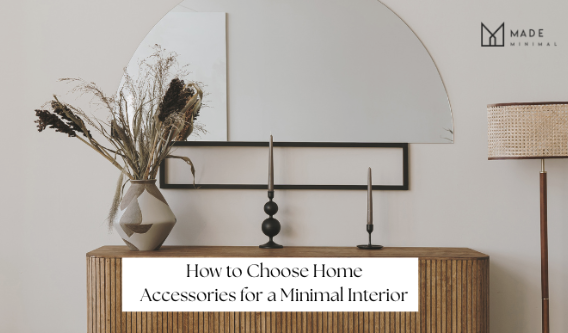
Home accessories for a minimal interior should complement the space through simple designs and functional value. Most people buy too much too soon when they start styling a minimalist home. But then the decor style they wanted gets lost in small purchases that seemed reasonable at the time.
Meanwhile, a well-chosen item adds visual or practical value to a room, and a poorly chosen one only adds to the clutter. MadeMinimal is built around that exact idea: quality home decor that fits a compact interior design approach.
In this article, we’ll cover what minimalist home decor means and how natural materials and light influence a space. We’ll also talk about effective storage and the value of one strong statement piece.
Let’s find out how to decorate a home with breathing room.
What Is Minimalist Home Decor, Really?
Minimalist home decor is the practice of choosing fewer, selective items so every piece in your room has a clear reason to be there. It can be a clean-lined timber shelf, a ceramic lamp, or a linen cushion in a neutral tone.

In a simpler design, functionality and aesthetics are never separate ideas. The main elements include: clean lines, neutral tones, and furniture that serves a specific function.
Although minimalism is widely misread as cold or uninviting, a well-executed home feels calm precisely because the clutter is gone.
That said, visual noise competes for the brain’s attention and makes it harder to focus and process information efficiently. Minimalist design reduces these competing distractions by limiting unnecessary objects and giving each item a specific place and purpose within the space.
Minimal Home Accessories That Enhance Your Space
The right accessories make a compact area feel considered and calm, rather than empty or unfinished. Every piece is chosen for what it contributes to a minimalist home, visually and practically.

Here’s a general idea of how to decorate.
Choose Natural Materials Over Synthetic Substitutes
Natural materials add warmth without adding visual noise, which synthetic ones rarely manage. After working with a range of minimalist homewares, we’ve noticed that wood, linen, stone, and ceramic sit in almost any simple interior without competing for attention.
A timber side table, for instance, brings nature into the room in a way that looks built to last. On the other hand, synthetic alternatives (particularly plastic finishes) tend to look cheap under natural light. They also break the calm that minimalist interiors work hard to create.
Natural Light Is Your Best Interior Design Tool
Most people buy accessories first and think about light second. But in a minimalist interior, that order needs to flip. After all, natural light influences how every material, colour, and surface reads in a room.
For example, sheer curtains let light move freely through a space while keeping the austere aesthetic intact. To get this effect, avoid placing heavy or dark accessories near windows, since they absorb light that the room needs to feel bright and open.
The One Question to Ask Before Buying Any Home Decor
Before buying anything, ask one question: What does this do in my minimalist home?
Functional home decor can pull double duty, such as a bowl that holds keys near the front door, or a tray that organises remotes on a coffee table. They keep your room tidy and still look intentional while doing their job.
In our experience with people creating minimalist interiors, purely decorative pieces are usually the first things people wish they had skipped (a beautiful object that does nothing useful is just clutter with good PR).
Practical Storage Is a Minimalist Design Move
A beautifully styled shelf means nothing if the drawer below it is stuffed to capacity. In a compact home, storage is not separate from design. Storage and design work together, and many spaces become difficult to manage when that connection is overlooked.
Here are three storage approaches that align with minimalist principles:
-
Hidden Furniture Storage: Hidden storage solutions, such as ottoman beds, drawer bases, and console units with lift-up lids, keep everyday essentials accessible without cluttering the room. The same principle applies to bedroom storage, where a wardrobe with well-organised drawers helps keep clothing and personal items neatly out of sight.
-
Lidded Boxes and Baskets: A lidded box on a shelf stores smaller items neatly, which keeps surfaces clear and the overall space feeling calm and considered. They’re especially useful for everyday items that need to stay accessible without remaining on display.
-
Edited Open Shelving: This approach creates visual breathing room and prevents shelves from becoming a source of clutter. Open shelves especially work well when limited to three items per shelf, such as a plant, a ceramic object, and one book.
These three solutions show how storage and minimalist design support each other rather than compete. A compact home that handles clutter well looks effortless, and that effect requires proper planning.
One Statement Piece Beats Ten Small Ones
One well-chosen piece helps maintain visual simplicity, while multiple smaller items often make a room feel busy and fragmented. Through our experience styling compact spaces, we’ve found that rooms with one clear focal point often look more sophisticated than those filled with competing decorative objects.
Interestingly, minimalist interior design encourages you to think in terms of anchors. Say, one oversized planter, a sculptural table lamp, or a solid timber coffee table gives the room a clear focal point.
Here are three ways a statement piece improves a minimalist room:
-
Simplified Colour and Tone: Building your decor around one focal item makes it far easier to stick to a cohesive palette, since everything else supports it. As a result, colour choices tend to feel more intentional and less scattered throughout the room.
-
Stronger Visual Elegance: A single piece with clean lines and simple shapes, like a stone bowl or a sleek timber shelf, brings sophistication and beauty without visual noise. This way, the eye has a clear place to settle, which helps the room feel refined rather than crowded.
-
A Warmer, More Welcoming Feel: The right statement piece adds warmth to a minimalist home and enhances the overall aesthetic without introducing clutter. Natural materials, texture, or craftsmanship can provide character that a room might otherwise lack.
A simple style, when built around one strong piece, feels intentional rather than sparse. That one considered piece gives the eye somewhere to land without the room feeling pulled in ten directions.
Where to Begin With Your Minimal Home
Pulling a minimalist home together usually never happens in one shopping trip. The idea is to build slowly and choose carefully, since every piece you add either strengthens the space or works against it. Ultimately, fewer, better choices beat volume every time, and that principle holds when you’re styling a single room or an entire house.
A practical place to start is your surfaces. Clear them completely, then only return the items that serve a real purpose or bring genuine calm to the room. From there, think about storage, natural materials, and eventually one statement piece that ties the room together.
If you’re ready to find accessories and home decor that fit that vision, Made Minimal carries a considered collection of pieces built around that sense of simplicity and calm. Your aesthetic solution is already there, so visit us.